Showing posts with label LockeAndCage. Show all posts

Wednesday, January 27, 2021

Sherwood Cycle: What's In A Title

 One of the things I occasionally do is clean out my "Writer's Closet". 

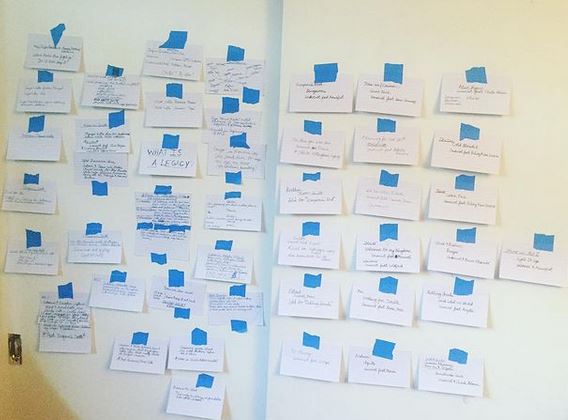
Except it's now more of a room than a closet. I always have a writing wall, where I write things about the project I'm working on--characters, scene outlines, music, bits of dialogue, etc--and that wall gets more and more full until I finish the initial draft of the project, when I pull all the 3x5 cards off the wall and start with a "clean slate", as it were.

 But because a wall has only a certain amount of space, I have to create files on my laptop and in various notebooks that are then stuck in my filing cabinet or my cloud drive or whatever because I'm the type of writer that keeps everything

And one of the things I keep is a list of possible titles for my project. 

I can count the number of times the first title for a project stuck on the finger of one hand.

That's one finger on one hand.


 One of my favorite authors once held a title contest for one of her novellas on her website(which was a really fun read), and another one made me feel even better when she gave some advice to her blog readers about writing any type of fiction. 

With the Sherwood Cycle, every single of the scripts has gone through at least three title changes, and not just because I can never make up my mind about anything(thank you ADD).

Recently I came across a little post-it note I scribbled on while writing "Wolves of Sherwood", and  there wasn't one title one it. There were four. 

Four different titles crammed onto this tiny piece of paper. 

I really used to bother me when a thing like this happened, but not so much anymore. 

Sometimes, my gut tells me the title doesn't work. 

Sometimes, my characters tell me the title doesn't work, and why(yes, I'm on speaking terms with all of them, it's an author thing, just go with it)

And sometimes it's just a Place Holder Title because you have to call it something other than that-one-project-i'm-working-on-but-can't-explain-cause-it's-complicated.

(Yes, I have called a few projects this before. Also a thing)

Another thing that I've learned over the past couple of years is that a title doesn't just have to work for you--sometimes it also has to give some kind of clue on how to market your project.

Don't believe me?

One of the greatest movies ever made, "The Princess Bride" was a box office flop for that reason--no one had any idea how to market it--even the trailer was a mess

Result?

Box office sales plummet, cast and crew suffers, and the film either "comes back via word of mouth/DVD(or in the case of "The Princess Bride", VHS" or disappears from existence except as an article on Google or whatever.

Because I'm the type of weird person who cares about that kind of thing, and I like to make things easier for all parties concerned, when I'm in the revision process one of the things I look at and constantly tweak and re-write is the title. 

Not even kidding.

And I'm glad that I'm not the only one.  

All part of the revision process.

Here's the next chunk of my current project's soundtrack, while I'm at it. 

Incidentally, it's not called "Robbing Hoods" anymore. 

Now it's "Out of Nottingham". 

Much better, in my opinion. 

Dear Agony(Aurora Version), by Breaking Benjamin & Lacey Sturm


Vivid, by Lemonade


Carry You (feat. Fleurie), by Ruelle


Are You Even Real?, by James Blake


Pull Me Down, by Mat Vansen


Far Away, by Breaking Benjamin & Scooter Ward


Never Too Late, by Three Days Grace


Game Face (feat. Sam Tinnesz), by UNSECRET


White Flag, by Bishop Briggs


Wednesday, February 12, 2020

Thespian Musings: Table Reads--the Good, the Bad, and the Ugly

Hey.

Hi.

Can you spell T-E-R-R-I-F-I-E-D?

I can.

Cause I'm about to put my latest script("Lure of the Fox") in front of a bunch of my peers for a Closed Amateur Table Read.

What is a Closed Amateur Table Read, you ask? It's when the script you have slaved over for doesn't matter how long finally gets read by (hopefully) a group of very supportive friends.

For the First Time.

Out Loud.

And then--if all goes according to plan--it gets shredded within an inch of it's life and you take the pieces and start all over again.

Also known as Revision.

Yay?
Image result for frantic screaming gif

The good news is that it's not a professional read, so there are no financiers or audience members in the room in case I happen to make a Big Social Gaff.

Which I am sometimes wont to do(thank you ADD😛).

I've done a couple of these Table Reads now both in academic and other amateur settings as both an actor and at playwright; and there are ways to make them successful and ways to make them....suck.

So this week it's about the Good, the Bad and the Ugly of Table Reads, complete with my dorky little anecdotes. Some of them apply to all Table Reads, some are just personal preferences,  cause that's how I roll!

"Do"s and "Don't"s of a Table Read(According to This Theatre Artist)

DO:

DO Plan Ahead
When I was a theatre major, I had a group of people that I could usually snag for a quick read like a week in advance and then we'd get together in an empty classroom to read the script. That, or we'd read the script as part of a class assignment(like in New Script Workshop or something).

That is not the case outside of school.

We all have busy lives: day jobs, families, social-obligations-outside-of-the-theatre, etc.; so when you're going to do a reading of your script, create an event on Facebook, or in Eventbrite, or Meetup or whatever and invite people to see who happens to be available.

My highest success rate is when I do it a month in advance at least. If you're really lucky, you can do it a week in advance, but chances of success are super slim.

Image result for script
At least in my experience.

DO Send Out the Right Script
I'm not kidding.

Double check and triple check that everyone has not only the right script, but the right draft of the script before the reading takes place.

The first Table Read I ever had was my second year as a theatre major, so it was part of a class assignment.

I got my actors together, scheduled my time-slot, showed up to class with notebook and pen and ready to take notes and get feedback.

And the actors started to read.

And a few of them looked really confused.

And after about fives minutes, one of my actors said "um, I think I have the wrong script." And another actor said "yeah, me too".

Guess what?

I'd sent out three different drafts.
Image result for oops gif

As far as I can tell, what happened was that each time my actor friend said yes to coming to my class, I'd sent out what I thought was a copy of my current draft.

Except each time, I'd made changes to the previous draft as saved that one instead.

And now the whole class knew about it.

Can you spell M-O-R-T-I-F-I-E-D? I can.

Once you send out your script to the actors leave it alone. Save it as a PDF if you have you, so that you don't even have the temptation.

DO Your Homework
If you're the playwright/screenwriter your homework is making sure that the script gets sent out on time(say 3-7 days before the reading) and compiling a set of questions(mental or otherwise) that you can potentially ask. If you trust the actors enough, you can even send the questions to them ahead of time so that they are thinking about their answers while reading the script.

If you don't have any specific questions(I usually start my post reading Q&A Session by saying something like "shred me!"), be prepared to answer questions that will be asked by the other actors.

You will get them.

I promise.

And it's ok to say "I don't know". That's a clear signal that there is some revision that needs to happen, which is always a good thing.

If you are an actor the first part of your homework is the read the script beforehand, if you have time. Even if all you read is stage/camera directions and scene headings.

I'll say that again.

Read the script beforehand if you have time.

Even if all you read is stage/camera directions and scene headings. 

Understanding writers will know that your world doesn't revolve around their reading.

But if the writer is anything like me, they will get the impression that a particular line of dialogue that was stumbled over is clunky and needs revision, when maybe the only reason the actor stumbled is because he/she/they hadn't read the script before the reading.

Image result for be preapred

There is nothing more frustrating than stumbling over lines that you haven't read before.

You have other obligations.

We get that.

And that's ok. We're all busy. But if you have time, it's better in the long run.

The second part of your homework only applies if you got questions from the writer beforehand.

Read those questions.

Apply those questions to the script.

Have answers so that you can provide them when needed.

Homework isn't as big a deal in closed amateur settings, but in the professional world, if it's clear you slack off, you could get fired. So practice homework now for professionalism later.

DO Provide Sustenance 
Every single reading I have had outside an academic setting, I've made everybody food.

Sometimes it's a full meal, sometimes it's just cake(I love cake!!).

Image result for cake

People might bring water bottles cause they talk so much(scripts are full of dialogue after all), but energy can sap even when all you do is read, and water doesn't replenish energy.

Like at all.

You don't have to host a formal dinner while you read, but it's totally ok to break in between acts(which is much easier in a play script than a screenplay) to allow your actors to replenish and refill. This will prevent burnout--which is a thing even at readings.

Also, it's a great way to thank people for helping you out without breaking the bank.

(Quick Note: when you do this, it's best to stick to Actors Guild/SAG Break Rules: 10 minutes break for every 80 minutes of rehearsal time just so you don't go over your allotted reading time)

DON'T:

DON'T Read it Just to Read It
Several times in academic settings, I participated in readings where the author came in, we read the script, they said "thank you" and walked out.

No feedback, no nothing.

Image result for say what gif

Call me crazy, but find this unproductive.

In my book, you hold a reading not just so you can hear it out loud, but also so that you can improve your work. If all you wanted was to read it, then why didn't you do it yourself?

Hold a reading because you want to, not just because you need to.

Saves everybody a headache.

DON'T Ignore Feedback And/Or Be Offended
Guess what?

Everybody has opinions. Everyone. If they don't they ain't human.

Part of a reading is the giving and receiving of feedback, also known as readers expressing opinions of what can be stronger, what makes no sense, and what should be thrown out the window.

And while you should take everything said with a grain of salt (because sometimes the feedback is either pure opinion or the "you can't write so I'm going to write it for you" variety), there are still things you need to do in the feedback stage of the Table Read:

Write down every single thing that is said.

I'm serious.

Write it down.

Think about it.

Let is stew.

Then go back and delete the things that are pure nonsense--because there's going to be those types of notes.
Image result for don't be offended

Getting feedback hurts sometimes. It's like lying your baby naked in front of hungry machete wielding cannibals and saying "have at it". They don't hold your script in the same type of esteem that you--the writer--do. That doesn't mean that they hate you, or the script. It means they respect you and want to help you improve.

(there are those very rare times when people say things that are deliberately unhelpful because either they have a participation grade riding on this or they're just maddeningly  unhelpful grumpy people but I can count the number of times this has happened to me on the fingers of one hand)

Things people say are gonna sting. They're killing your darlings. Because of course they are so that your script can get better.

Listen to what they say. Think about it. They want to help you.


DON'T Expect People to Bring Copies of the Script
This is nitpicky, but it happens.

We currently live in a world with laptops, cell phones, tablets--hundreds of thousands of ways that we can access digital files. Sometimes actors will bring these digital files with them to read off their devices.

Other times, they won't(if it's a professional Table Read, it is your responsibility to provide all of the scripts for every single actor. Amateur readings have a little leeway).

My personal practice has been to have several copies of the script on hand for those actors who don't have copies with them--on my phone, my laptop, hard copies, whatever(if I'm feeling really generous, I'll even bind the hard copies so they look extra nice).

This will save time in the long run.

DON'T Go Over The Allotted Time
Best practice is to arrive on time or early to a reading.

But we are human.

There is traffic.

 Our car dies.

Our watch stopped.

Previous engagement accidentally bled over.

We just plain forgot.

It happens.

Particularly in the Amateur Table Read.
Image result for i'm late for a very important date

So, be prepared to compensate for late-comers, but do your absolute best to start and end the reading on time.

If you said it would run three hours, the reading runs three hours.

Not three and a half.

Not three and fifteen minutes.

Three hours.

People have lives. Unless it's a professional gig, they are nice enough to be doing you a huge favor, so you are obligated to respect their time as much as they are respecting yours.

Readings are fun. 

They are nerve-wracking.

They are part of a Theatre Artist's lifestyle. Follow the above "Do's and Don't's" and it'll be successful.

Now all I gotta do is get through mine.....


Image result for scared face

Wednesday, December 11, 2019

Thespian Musings and Sherwood Cycle: Plot Driven vs Character Driven

So here's the deal.

Wolves of Sherwood  and the as yet named prequel-prequel(aka my own version of a "Robin Hood Origin Story"--upcoming project for November 2020 fingers crossed), are plot driven stories.

Lure of the Fox and the final script in the cycle(tentatively titled Prince of the Blood, and with tidbits coming to this blog April 2020--yay!!!!) are character driven stories.

What exactly does this mean?

Allow me to enlighten you.

(For those Already Enlightened, you are welcome to skip this post and I won't hate you. Or if your Lazy and Want to Just Google It, that's cool too).

Still here?

Awesome, here goes.


Plot-driven stories are when the plot--the events--are the driving force of the story.

Meaning if you take away the characters, it's likely the events will happen anyway.

Aka "Who/How" Stories.

Aka High Concept Stories.

Aka every single high action "box office smash" that gets a summer release.

Aka:

1. The Fast and Furious Franchise
I love this franchise; I do--enough to own the first seven(I'm gonna see what the last three do before I see them on my small screen cause maybe once in theatres is enough, idk). But don't tell me that you would have a story if you took out all the cars and chases and explosions, cause you wouldn't. 

2. Every Thriller/Horror/Mystery Ever
The Mummy is about waking up something from the Dead. The Forest is about what happens after dark in a forest. Miss Marple/Sherlock Holmes/whoever would have nothing to do if nobody died. The Ocean's Eleven films are all about heists--events. "Knives Out" is the exception. Don't agree? We'll talk.

3. Every Single Event Biopic Ever
Pearl Harbor. First Man.  Red Tails. Midway. Selma. Newsies(Disney-fied, but still rooted--if shallowly--in a factual event). Hotel Mumbai. The Current War. Basically, if it's in the title, it's plot-driven.

4. Every Single Super-Hero Film Ever
Every single Avenger becomes an Avenger because of an event; every single DC character was shaped by an event; if the TMNT hadn't encountered the Ooz, they'd still be pet turtles. Change my mind, I'll wait.... 


Character-driven stories are when the characters are the driving force of the story.

Meaning if you take the characters out of the story, it crashes and burns a horrible death.

Aka Low Concept Stories.

Aka "Who/Why" Stories.

Aka:

1. The Prestige
Two men trying to outdo each other no matter the cost to themselves. I mean, it's bound to get ugly, but it's so fascinating to watch. And each twist of the plot is driven by a choice that the character makes--to outdo his rival.

2. Every Single Person Biopic Ever
 Hidden Figures, Freedom Writers, Julie& Julia, Shakespeare in Love(more fiction than fact, but still), Band of Brothers(Ensemble Character Driven), The King's Speech, Rocketman, Harriet. People make choices, and the story moves forward.

3. Every Single Coming-of-Age Film Ever
The Breakfast Club, The Perks of Being a Wallflower, Rumble Fish, The Outsiders, Honey Boy, The Peanut Butter Falcon. People make choices, and they make discoveries and the suffer the consequences(except, can you really "suffer" a good consequence? maybe use the biblical definition on that one), and the story moves.

4. The Joy Luck Club
When my twin brothers were six, PBS did a tv series based on Amy Tan's picture book, "Sagwa". So of course, I had to read the picture book. And then I had to read more Amy Tan, so I read this book and saw this movie about the lives of Chinese-American and Chinese women which was brilliant. And the story wouldn't happen if the women in the stories didn't make choices. 

The Now Novel website does an even better job of explaining both of the above than I did (see image below), so check them out too.


There's more than four of each, but this post is already long enough so Goggle can show you the rest.

Wolves of Sherwood  and the as yet named prequel-prequel are about how the characters are shaped by events to become who they are.

Lure of the Fox and Prince of the Blood are about the development of their protagonists and why they become who they become.

Cool huh?

Monday, November 25, 2019

Lure of the Fox: Month of Blood

Remember when I said that "Lure of the Fox" takes place in the colder months?

Well, as of now, I know exactly when it takes place.


Which is cool, considering what month it is right now...for the next five days anyway😛.

Ha ha.

Back in the Middle Ages, though, it wasn't called "November"--very much.  It was more commonly known as:

Blotmonað


Yeah, I have no clue how to say that, but that is how you spell it. 

And it means "blood month" or "the month of blood sacrifices".

See, back when the Anglo-Saxon calendar was a big deal, November was the time of year when it was likely that animal sacrifices were made so that the inhabitants could have a safe a relatively mild winter.

And stockpile for the winter as well.

Because, you know, food. 

These animal sacrifices were likely made when the leaves started to change color and fell off the trees, and it got stupidly cold.

But the sacrifices likely didn't begin until after the harvest was brought in, which was usually after All Saints Day.

Aka November 2.

Hence "month of blood".


November was also a time for bonfires and mischief, particularly because the previous holiday, Samhain, was when the veil between the living and the dead was thinnest, so it's also possible that the animal sacrifices were to appease any lingering spirits in addition to protection from the upcoming weather. 

Of course, Malbete would have his own twisted definition for "month of blood".

And he uses it. 

Especially when it concerns Jean-Luc. 

Because he's so very twisted like that. 


Wednesday, November 20, 2019

Lure of the Fox: Romani

I said last week that Sorcha and Tirzah can code switch right?

And that there's a reason behind that?

Well, the reason has to do with their genetic, ethnic and socio-economic makeup(a phrase that I absolutely love and will use at any given opportunity, and not just cause it's fun to say).

Sorcha and Tirzah are Romani.

The Romani Flag
(Also spelled "Romany"; also referred to as "Roma", "Rom" or  "gypsies"--which is actually regarded as a derogatory term among the Romani people because of the way this term was used--as a source of abuse and racial discrimination; though there is some evidence that this term came from a misunderstanding of the Romani's origin. This evidence suggests that the word "Gypsy" came from "Egyptian", since it was thought that they migrated from Egypt, rather than northwest India. But I digress...)

Actually, in France, they are referred to as "Gitans" but I'd rather not do an exposition dump in any of my plays, so I'm using "Romani".

Romani have intrigued me since I first read "The Hunchback of Notre Dame"--which has a highly glamorized (and some would say bastardized) interpretation of a Romani in the character of Esmeralda.

And researching the non-fictionalized Romani has been fascinating. For instance:

They are nomadic by necessity.
Romani were among the ethnic groups enslaved by noblemen of the regions they inhabited and were among those rounded up and sent to concentration camps in World War II.

Interested parties can find a little more info on this topic here.

Which explains why Sorcha and Tirzah are so capable of looking after themselves--not that non-Romani are less capable, but...you get the idea, I hope.

They adopt the predominant religion of the region they inhabit.
Romani have spiritual beliefs, and complex rules that govern respect, honor, purity and justice. But they don't follow a single faith. If they happen to be in a predominant Catholic area, then they practice Catholicism, for example. They also have thier own worldview, known as Rromanipé.

Which, while religion doesn't totally come into play, in "Fox", it helps back up a couple of plot points(like Jean-Luc and Tirzah's marriage...spoilers....)


Language

Romani speak a language known as Rromanës, which has roots in Sanskritic languages like Hindi, Punjabi, Urdu and Bengali; and some words have been borrowed from English. 

And this is why Sorcha and Tirzah are able to code-switch. They speak three languages. 


Family is the strongest value held in Romani society.

According to the Rroma Foundation, "Rroma never had a country — neither a kingdom nor a republic — that is, never had an administration enforcing laws or edicts. For Rroma, the basic 'unit' is constituted by the family and the lineage." 
How cool is that?!


Also, lends stronger motivation to Tirzah's actions in the plot of "Fox".


They still face discrimination, persecution and racism today

Romani in Auschwitz
Because or the color of their skin, and/or their culture, and/or anything-else-sure-to-piss-off-anyone-who-fears-and/or-doesn't-understand-a-culture-or-people-different-from-their-own. See nomadic by necessity above.

Also, guess what one of the underlying themes of "Fox" is?


If I piqued your interest, there's more to find out by following this link here.


Also, there is an amazing TEDtalk about the Romani here.

Wednesday, November 6, 2019

Lure of the Fox: Reflection of Personality

It's NOVEMBER!!!!

Which means it's NANO!!!!

Which means I will use this as an excuse to finish this draft of "Fox" by November 30th, so help me!!!!!

Meantime, here's another tidbit.


One of my favorite authors--Lauren Willig(who I talk about so much both on an off this blog I'm surprised people aren't sick of hearing it yet) said something somewhere about how the atmosphere and plot of a story/plot line can reflect the personality(ies) of the protagonist of said story/plot line.

(Lauren says it a lot more eloquently than I just did and I rooted around on her website for like an hour trying to find that exact quote but to no avail. Grrrr. But I got the gist, soooooo)

You guys, I'm finding that this is absolutely true.

Confession: when I started out writing what is fondly becoming known(to me, at least) as the Sherwood Cycle, I didn't intend it to be more than one show.

But, as it usually the case, I fell in love with so many of the characters(as is my wont) that I had to write more of their stories(and I'm repeating myself, I know).

Wolves of Sherwood took place in the summer.

Wolves of Sherwood was super swashbuckling.

There were 11 fights

(more in the Utah production, because we had three fight choreographers--one main choreographer and two fight captains/assistants--rather than one. Which was cool.)

 And, while there were some dark things that happened in the plot,

for the most part in Wolves of Sherwood, everything was light and frothy and gave you warm fuzzies.

However.

Lure of the Fox is not Wolves of Sherwood.  And not just because the title is different(ha ha).

It's darker.


Fox takes place in the autumn/early winter(the most important part is that there is no snow, cause I hate snow).

It's not frothy and whimsical and dappled sunlight and all of that.

There's shadows and cold and broodiness and darkness--both atmosphere and people-wise.

 It's grittier.


Fox's events occur in a war-torn country,

complete with mercenary thugs and the like,

and, it's me,

so of course there will be combat.

Just not as much--

and those fights are shorter, harsher, bloodier...

because why not(ok, fine, there is a legitimate reason, but still)....

It's heavier.

Stakes are higher.

Consequences are more dire.

Themes are more mature.

Get the picture?

It's sexier.

We get to see what happens when a tiger and a fox-bear get together.

Because yes.

'Nuff said.

It's more cerebral.

There's plenty of emotion and sword fights and the like,

but it's less swashbuckling,

and a lot more internal

 with a heist type plot line, rather than straight up action/adventure.

 Also, it's becoming a lot more character driven,

which is interesting,

as WOS was mostly plot-driven.

Also, also, there's more French.

A lot more French.


All of which actually fits Jean-Luc's personality to a T.

He's cerebral(an emotional cerebral, but still),

he's dark and broody,

he's gritty,

he's incredibly sexy (in my mind anyway, because y'all know how I feel about Dark Horses and their personalities, and it doesn't help my romantic heart that he still looks like Harry Richardson--who is Drake from Poldark--in my head:)

And he's like a dormant volcano,

with thoughts and emotions bubbling beneath the surface

that will explode if not released sooner or later.

But explosions always have consequences.

And it's always really fun to watch those play out!

Monday, October 21, 2019

Thespian Musings & Lure of the Fox: Hazards of Being a Playwright

 So once upon a time, I went on family vacation.

My family really likes to do outdoorsy things(except me) so we planned a hike to---someplace I don't remember where exactly--so we all had backpacks and water bottles/camel-backs and snacks and the works.

And, because I write 24/7(sometimes literally) I had a notebook and a pen in my backpack--the latest draft of a script I was working on. 

We went and did the hiking thing and when we got to wherever it was and stopped for snacks/lunch/rest(or in my case recoup), I took out my notebook and my pen and did some writing. 

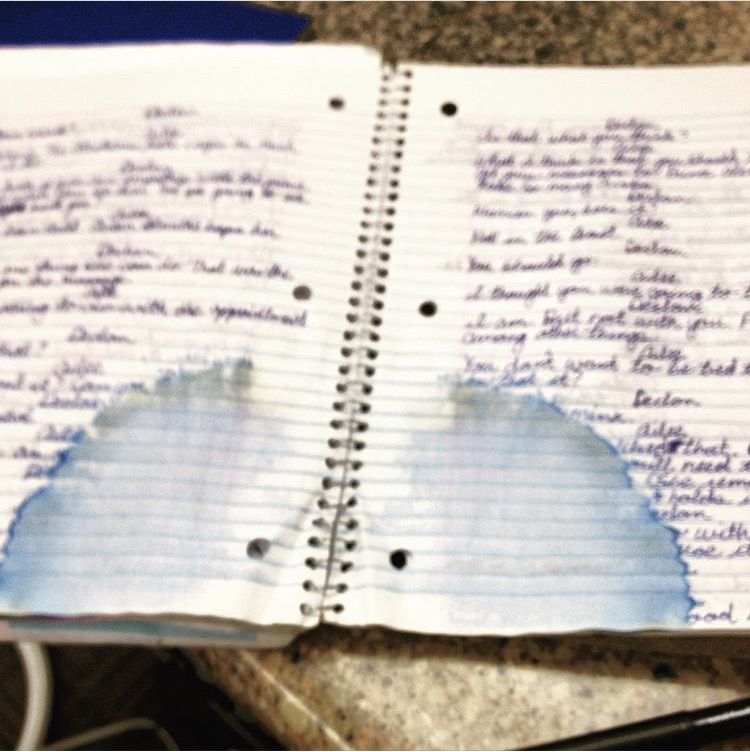
And when we got back to our rental house I emptied my backpack to get ready for next day activities and saw this:

Apparently my water bottle was not closed, or something because my entire notebook was soaked all the way through.

Which meant that 75 pages worth of writing were next to useless.

Which meant I had to start my script all over again.

Can you spell C-A-L-A-M-I-T-Y?

And, ok, fine, it was not the end of the world but it was still enough to make me grind my teeth and mutter about "stupid-hikes-and-stupid-water-and-ruined-have-to-stupid-do-all-over-a-stupid-gain"(and that's the filtered version).

You would think I'd have learned my lesson. 

HA.

Flash forward...several years to now. 

August.

Wolves is in rehearsal and I'm plugging away at Fox.

In a notebook. 

Which I'm supposed to carry around with me at all times.

Until one night, I left it in the rehearsal space.

I

Left 

It 

In 

The

Rehearsal 

Space.

And since we were sharing it with other people it probably got thrown away.

And it was fine.

It was fine.

It was totally fine.

I had most of Act II(which was the contents of said notebook) already typed up and I'd worry about the mini plot-holes later and just get to work on Act I--which is probably what I should have done in the first place, but as I said before, I write things backwards.

So I started writing again--this time from the actual beginning, and it was nice. I carried my new notebook around with my new pen(because yes I needed a new pen with my new notebook; it's a thing; shut up) back and forth to day job and rehearsals and everywhere else.

And somewhere between getting from point A to point B I lost that notebook too.

Just like that.

All gone.

Disappeared.

Lost.

Kuput.

Which was awesome.

Grrrrrrrrrrrr.

Soooo I got to start over.

Again.

However,

The upshot of all this is that the old saying "third time's the charm" is actually true in this case.

Yes, I was frustrated cause I had to start from scratch each time.

But each time I was getting a new notebook and a new pen and adding to/cutting from my playlist soundtrack for this script I had a lot of time to think.

Which turns out to be exactly what I needed.

Because when it comes to my scripts and my characters I get


I was happy with what I had before.

I was.

But what I'm working on now is so much better.

Things that didn't click before now are falling into place.

Plot holes I thought I'd have to deal with aren't plot holes anymore.

And I've made new discoveries about my characters.

One of which made my head explode 😛

Lesson?

Make sure your water bottle is closed when it goes in your backpack

Make sure you know where your stuff is, and back it up(like maybe in two or three different places just in case).

Sometimes when things "blow up" in your face, it's cause your Muse is telling you that you have to start over

and you if you don't listen to your Muse or whatever the first time

your Muse will beat you over the head until you do.

Result?

"Fox" is so much better!

And so much fun!

Which means I go home every day to the Writing Cave and emerge every night from the Writing Cave with a big stupid grin on my face.

End of entertaining anecdote.

Wednesday, October 9, 2019

Lure of the Fox: Writing "Backwards"

Oh, look at that, concept trailer shoot is over,

and I'm still alive,

and my life is not as insane as I thought.

Which means I get to go back to the Writing Cave.

YES!!!!!

So y'all know by now that I tend to write characters and plots with a ton of history

 because I'm weird like that

 and it's fine

because it leads to the potential of sequels and prequels and things(this has happened more than once and I'll chat about that sometime later).

Way back in July, when I was still in the "development" phase of "Lure of the Fox", I hadn't really thought much about the characters beyond "oh, yeah, Cassian and Jean-Luc, and Ravenna and Tirzah, and Tarquin, DeClaire and Malbete are in this; and I already know their "Animal Parallels"; and there are only three additional characters(Declan, Sorcha, and Reynaud) which means this cast is smaller which means this will be easier to write. Cool."

HA.

Now that I'm in the "writing" phase, it just got....interesting...and (especially for someone like me who overthinks E-V-E-R-Y-T-H-I-N-G) complicated...

"Fox" Tarquin is easy to write.

"Fox" Jean-Luc, Cassian, Ravenna, Tirzah, DeClaire and Malbete are not.

Why?

Because these particular "Fox" characters are different from the way they are portrayed in "Wolves"(because prequel)--especially when it comes to certain personalities.

These particular "Fox" characters are being written "backwards".

Allow me to illustrate:

Jean-Luc
"Lure of the Fox" is Jean-Luc's story.

(And I'm not gonna lie, this made me do a mini happy dance cause I've been more or less in love with this Dark Horse since I created him three years ago)

Which means we get to see the Fox/Bear show his teeth!
 

He's reckless.

Jean-Luc decides he's going to to go play hero and damn the consequences.

I know!

And he has a rage problem.

Jean-Luc has a temper, and that temper gets him in over his head.

I know!!

And he's impulsive.

Jean-Luc leaps before he looks(sometimes literally), and ends up screwing himself and everyone else over.

I KNOW!!!

Cassian
Since Cassian takes the spotlight in "Wolves", he's been relegated to a supporting character in "Fox"(see Jean-Luc above).

But this time, Cassian is the cautious one.

This time, Cassian follows the rules.

This time, Cassian's the innocent. A little boy who has yet to grow up.  Someone who actually listens when Jean-Luc tells him to do something, which is new. 

And kind of endearing.

And a fun 180 to give him--a cute untested little wolf pup.


Tirzah
Since Jean-Luc is the Male Lead in "Fox" it stands to reason that Tirzah is Leading Lady, right?

(cue inner squealings cause I love this girl so much I can't even)

Which also means that we get to dig into Tirzah's backstory.

And it's all sorts of interesting.

She's still sassy, and feisty; she can absolutely look out for herself; but there's also a darker aspect to her that we don't really see much of in "Wolves".

Tirzah's on her own, and she has trust issues.

So don't mess with this Tiger.

Unless you're Jean-Luc.

He can handle her just fine 😛

Malbete
Malbete's devious.

He's sadistic.

He's manipulative.

And you get to see all of that in "Fox."
This is a Malbete who doesn't have someone holding his leash.

The weasel bares his fangs.

 He's given carte blanche to do whatever he wants to any of his prisoners.

And to one prisoner in particular.

And it's glorious.

Ravenna
Just as Cassian's role in "Fox" is smaller, so is Ravenna's.

Just as Cassian is an innocent rather than a cocky show-off, so is Ravenna.

An innocent brat.

She knows her rank and expects to be waited on;

she expects to be looked after rather than looking after herself.

She's a bratty little girl, who's still an adorable little raven chick, if that's possible.
But it also means that Cassian isn't going to fall for her crap.

Which is awesome!

DeClaire
Oh DeClaire.

The loose cannon.

When I was writing "Wolves" I was always curious why DeClaire was so power-hungry and why he went off the deep end when he did.

It's because of who he was in Normandy.

And what he was allowed to do in Normandy.

A loose cannon is scary enough.

But a loose cannon sans leash is worse.

This is one snake you don't want to piss off.

*Shudder*

My Conclusion?

This is actually a lot more fun and a little bit more complicated than I thought it would be.

Writing characters "backwards" is hard.

Fun, but so effing hard.

Monday, September 30, 2019

Lure of the Fox: Animal Parallels

Right, so now that my life has calmed down for a Hot Minute(I have a concept trailer shoot this weekend, so we'll see how long that lasts...) I'm glad to able to go back to "Lure of the Fox"!

People who have read this little blog(and also who know me outside of this) are aware that in "Wolves of Sherwood", each character had a "spirit animal" in my head.

That was a cool little quirk to have

 A) Because it was fun, so why not;

and

B) Because a couple of animal references were in the dialogue so why not give all the characters an "animal parallel" which would mostly stay in my head since it was just for fun.

Except it didn't stay in my head.

All of them eventually made their way into the script.

Which is what happened this time.

So here, for your pleasure, is yours truly's animal parallel list for "Lure of the Fox". Enjoy!

Jean-Luc:
Bears are symbols of power, courage, confidence and introspection(yes, that is a line right out of WOS)and it suites Jean-Luc cause he thinks waaaaay  too much. Foxes are clever, and cunning and that gets them into trouble. A lot. If I told you why Jean-Luc has two Animal Parallels, that would fall under Spoilers, so...yeah, he has two; moving on...

Tirzah: 
Tigers are used as symbols of protection and healing, which is exactly what Tirzah is--a healer, I mean. Other things tigers represent is raw feeling and instincts--the ability to trust oneself and  follow your intuition. Which is what Tirzah does. Also, if you piss her off, she will claw you to death.

Declan: 
This one is kind of interesting. Scorpions are symbolic of defensiveness, protection, treachery, and passion, among other things. Declan is always on the defensive, and closes himself off from everyone and everything, but has a protective connection with Jean-Luc, so...yes, he's a scorpion.

Raynaud: 
Spiders represent shrewdness, resourcefulness, determination and patience--all qualities that Raynaud has. They are also really creepy to look at(especially the ones that seem to scoot over surfaces rather than crawl--that's both creepy and gross!). And this fits because Raynaud is also creepy as all get out.

Cassian:
There is a reason this is one of my favorite animals. Courage, strength, unyielding loyalty, uncanny instincts. All of these are present in a wolf; and all of these are present in Cassian. He just hasn't figured out how to use some of them yet.

Ravenna:
Another interesting one. Ravens can represent loss, sadness and death. However, they are also a symbol of freedom--the "don't tell me what to do" type of freedom. Which Ravenna has in spades.

Tarquin:
Apparently, both of the Gisbourne kids have bird symbols, which is cool.  Hawks stand for vision, intensity, strategy, and power. Tarquin posses all of these qualities.

Sorcha: 
And just as the Gisbourne siblings are both birds, the Massimo girls are both cats. Panthers represent courage, intelligence, valor and tact. Sorcha absolutely has more tact than Tirzah, but if you piss her off she will also claw you to death.

DeClaire: 
Snakes are connected to life changes(like life and death), duality and transformation. DeClaire certainly brings about those life changes, and he is absolutely two-faced. Also, snakes bite or attack when threatened, which, again, is what DeClaire does the little...jackass....

Malbete: 
Ok, first, don't make a weasel mad. They will tear your face off, no joke, the aggressive little suckers. Weasels are symbols of stealth and the cycle of life and death. Huh. No wonder this suits him so well.....